3-D Map
Town
University
Golf
History
People
Attractions
Fife
News
Accommodation
Dining
Online Shop
Businesses
Discounts
Screen Saver
Bulletin Board
Greeting Cards
Quiz
Misc.
What's New
Search
Castle - Mine and Counter-Mine |
 VR postcard |
     Tour: Castle - from the courtyard well * Visit: |

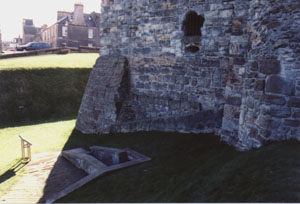
Castle - Mine and Counter-MineDuring the seige of the castle by the Earl of Arran in 1546 - 1547. The French / Catholic attackers dug a seige mine in an attempt to (literally) undermine the foundations of the castle. The idea was to remove a large quantity of supporting rock from under the foundation, while supporting the roof of the mine with timber. When sufficient rock had been removed, the timbers would be set on fire and thus become unable to support the weight of the wall and foundations. This was very hard and dangerous work, especially in St. Andrews where the mining was done by pick axe through solid rock. The technique for this type of seige was well known. There having been a good example of its use in the seige of Rochester castle in the early 13th century.
The mine was re-discovered in 1879 when the foundations for a house, across the street from the castle, were being installed.
|