3-D Map
Town
University
Golf
History
People
Attractions
Fife
News
Accommodation
Dining
Online Shop
Businesses
Discounts
Screen Saver
Bulletin Board
Greeting Cards
Quiz
Misc.
What's New
Search
Holy Trinity Church |
 VR postcard |
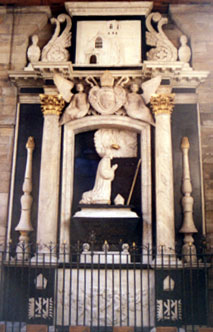
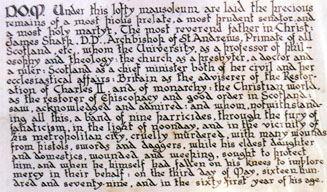
     Tour: Church Square | South Street - Church Street Visit: Archbishop Sharp's Tomb |

Holy Trinity ChurchMention of Holy Trinity Church has been found as early as 1163. At that time it was located closer to the cathedral. The present building dates (in parts) from around 1412. John Knox preached here with considerable vigor, inciting crowds to ransack the cathedral in 1559. An unlikely legend says that the pulpit from which Knox preached is now located in St. Salvator's Chapel. Above the Iona marble pulpit hangs the battalion standard of the 2nd Fifeshire Militia, which was formed in St. Andrews at the time of a threatened invasion by Napoleon. In 1800 the church was greatly altered from it's 1412 design, but it was restored again in 1909 to much of its former (1412) layout. Even today the church is indeed a museum of St. Andrews' history, containing such artifacts as the relatively benign "penitant stools" to the more macbre instruments called "branks" used to silence the tongues of those found guilty of gossip or blasphemy. Archbishop Sharp is said to have ordered their use on a woman who opposed his preaching in 1673. An original wooden pew bearing the royal coat of arms of Mary Queen of Scots is still in the church. The church tower was at one time also used as a prison.
|